7,000 vs 10,000 Steps: What the 2025 Lancet Study Actually Says
A 2025 Lancet review linked 7,000 steps a day to 47% lower death risk vs 2,000. What that means, what it doesn't, and why 10,000 lives on.
Key takeaways
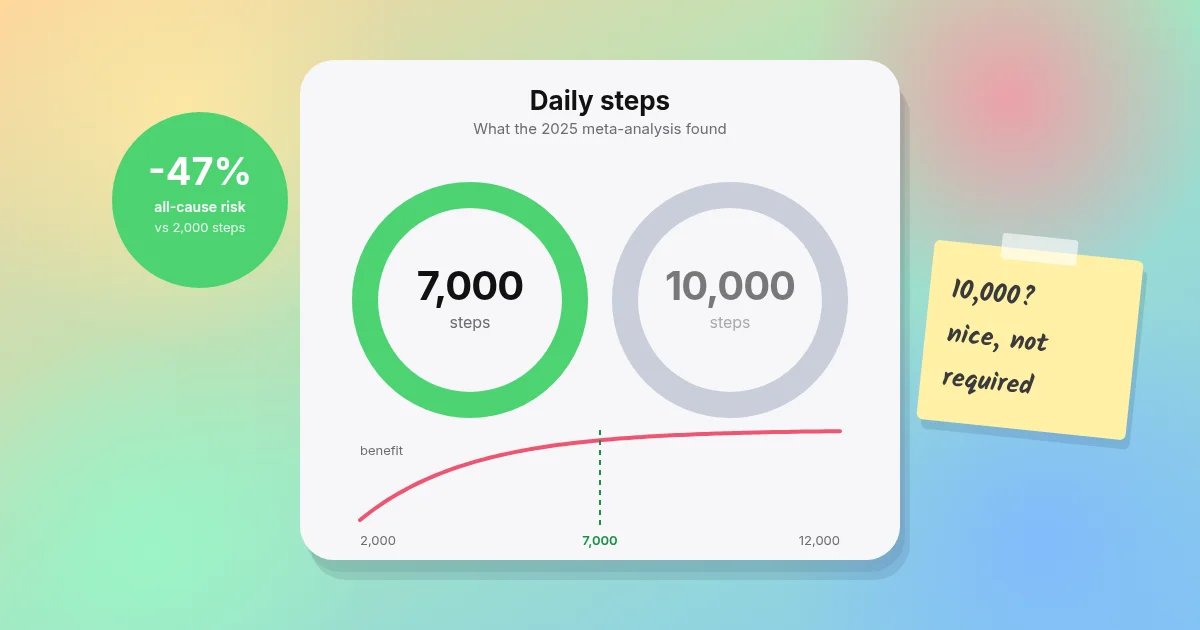
- A 2025 Lancet Public Health meta-analysis of 57 studies found that 7,000 steps a day, compared with 2,000, was linked to a 47% lower risk of death from any cause.
- For death, heart disease, dementia and falls, most of the benefit arrived by about 5,000–7,000 steps. Some outcomes kept improving beyond that.
- 10,000 started as a 1960s Japanese pedometer slogan, not a research finding. It's still a fine goal if you already hit it.
- These are observational associations, not guarantees. The practical takeaway: if you're under 7,000, adding steps is worth it, and every 1,000 counts.
For most adults, about 7,000 steps a day captures much of the health benefit that the research links with walking. That's the headline from a large 2025 meta-analysis in The Lancet Public Health. Compared with 2,000 steps a day, 7,000 was associated with a 47% lower risk of dying from any cause during the studies (Ding et al., 2025). Ten thousand isn't wrong. It just isn't the magic line it's often sold as.
Health disclaimer: This article is for general information and isn't medical advice. If you have a health condition or haven't been active for a while, check with a doctor before changing your routine.
So is 7,000 steps a day enough?
For the outcomes the researchers could measure, 7,000 looks like a strong, realistic target. For all-cause mortality, heart disease, dementia and falls, the risk curve dropped steeply as steps went up and then flattened, with the bend at around 5,000–7,000 steps a day (Ding et al., 2025).
"Enough" depends on your goal, though. For a few outcomes, including heart-disease deaths, type 2 diabetes and depressive symptoms, the relationship looked more like a straight line, so more steps kept helping. And step count says nothing about strength training, which matters too.
What exactly did the 2025 Lancet study find?
The study, led by Melody Ding at the University of Sydney, pooled research on daily steps and health. It included 57 studies from 35 cohorts in the review, and 31 studies from 24 cohorts in the meta-analyses (Ding et al., 2025).
Comparing 7,000 steps a day with 2,000:
| Outcome | Risk at 7,000 vs 2,000 steps/day | Certainty of evidence |
|---|---|---|
| Death from any cause | 47% lower (HR 0.53) | Moderate |
| Cardiovascular disease (new cases) | 25% lower | Moderate |
| Cardiovascular death | 47% lower | Low |
| Cancer death | 37% lower | Moderate |
| Cancer (new cases) | 6% lower (not statistically significant) | Low |
| Type 2 diabetes | 14% lower | Moderate |
| Dementia | 38% lower | Moderate |
| Depressive symptoms | 22% lower | Moderate |
| Falls | 28% lower | Very low |
Source: Ding et al., The Lancet Public Health, 2025 (DOI; PubMed). HR = hazard ratio.
Some rows rest on only two to four studies (dementia on two, falls on four), which is why the certainty ratings matter. The authors still describe 10,000 steps as a viable target for people who are already more active. Their point is that 7,000 is a more realistic, evidence-based goal for most people.
It also fits earlier work. A 2022 meta-analysis of 15 cohorts in the same journal found that the risk of death levelled off at about 6,000–8,000 steps for adults over 60 and 8,000–10,000 for younger adults (Paluch et al., 2022). A 2019 study of 16,741 older women found that about 4,400 steps a day was linked to lower mortality than about 2,700, with the benefit levelling off at around 7,500 (Lee et al., 2019).
Where did 10,000 steps come from?
Marketing, mostly. Yamasa, the Japanese company behind the first consumer pedometer, says it launched its "Manpo-meter" (万歩メーター, roughly "10,000-step meter") in 1965, the year after the Tokyo Olympics. It was built to support a "walk 10,000 steps a day" movement started by doctors and journalists, and Yamasa explains the number as roughly 7 km at a 70 cm stride (Yamasa).
Researchers have called it a catchy business slogan that stuck (BBC). The BMJ agrees the target comes from a successful mid-1960s marketing campaign rather than a study (BMJ). Round numbers are easy to remember. That doesn't make them physiology.
Is 10,000 steps a day pointless, then?
No. Several outcomes in the Lancet review kept improving past 7,000, and Paluch's analysis found that younger adults levelled off higher, at around 8,000–10,000 (Paluch et al., 2022). If you hit 10,000 comfortably, there's no reason to stop.
The problem with 10,000 is psychological. If it feels out of reach, people give up, even though going from 2,000 to 5,000 steps is where the biggest drop in risk shows up.
What are the study's limits?
Read the headline numbers carefully:
- These studies are observational. People who walk more may also be healthier in other ways. Researchers adjust for that, but they can't fully rule it out. This doesn't prove that steps cause the lower risk.
- Step counts are usually measured over about a week, then outcomes are followed for years.
- Devices differ. Waist pedometers, wrist trackers and phones count steps a little differently.
- Some outcomes have thin evidence. See the "certainty" column above.
- Intensity is mostly missing. Step totals don't tell you whether those were brisk or slow steps. Lee's study of older women found total steps mattered more than stepping speed once totals were accounted for (Lee et al., 2019).
How many steps should you aim for?
A sensible, evidence-based approach:
| If you're currently at… | Try aiming for… | Why |
|---|---|---|
| Under 4,000 | +1,000 a day each week or two | The steepest part of the benefit curve |
| 4,000–7,000 | 7,000 | Where most curves start to flatten |
| 7,000–10,000 | Keep it, add some brisk minutes | Some outcomes keep improving; intensity helps fitness |
| 10,000+ | Whatever you enjoy | You're past most of the plateaus; add strength work |
If you want more fitness, not just more steps, faster walking makes a difference. We fact-checked the viral Japanese walking interval routine, and covered how to raise your VO2 max.
How can you add steps without a gym?
- Walk the first 10 minutes of every call.
- Get off a stop early, or park at the far end of the lot.
- Take a 10-minute walk after meals.
- Do errands on foot if they're under about a mile (1.6 km).
- Make the morning walk a habit. We wrote about pairing it with a protein breakfast in the easiest way to lose fat.
A 30-minute walk is roughly 3,000–4,000 steps for most people (McGill OSS), so one walk can take you from "sedentary" to the 7,000 zone.
How do you track steps without oversharing?
Your iPhone already counts steps. The question is where that data ends up. Kinetic reads steps and workouts from Apple Health (read-only) and shows your day as a timeline of walks, places and sleep, without an account. Your health data stays on your iPhone and is backed up to your own iCloud, and we never see your health or location data. There are no ads, and we'll never sell your data.
Kinetic arrives on the App Store Nov 3, with your first year free.
Sources
- Ding D, et al. Daily steps and health outcomes in adults: a systematic review and dose-response meta-analysis. The Lancet Public Health, 2025: https://doi.org/10.1016/s2468-2667(25)00164-1 (PubMed: https://pubmed.ncbi.nlm.nih.gov/40713949/)
- Paluch AE, et al. Daily steps and all-cause mortality: a meta-analysis of 15 international cohorts. The Lancet Public Health, 2022: https://pubmed.ncbi.nlm.nih.gov/35247352/
- Lee IM, et al. Association of step volume and intensity with all-cause mortality in older women. JAMA Internal Medicine, 2019: https://doi.org/10.1001/jamainternmed.2019.0899
- Yamasa, history of the Manpo-kei (Japanese): https://www.yamasa-tokei.co.jp/top_category/history2.html
- BBC News, "Do you really need to take 10,000 steps a day?": https://www.bbc.com/news/magazine-33154510
- The BMJ, on the origin of 10,000 steps (2024): https://www.bmj.com/content/384/bmj.q598
- McGill Office for Science and Society, "10,000 steps: myth or fact?": https://www.mcgill.ca/oss/article/health/10000-steps-myth-or-fact