Japanese Walking: The 3-Minute Interval Routine, Fact-Checked
Japanese walking (3 min fast, 3 min easy) went viral in 2025. We read the Shinshu University studies: what they found, what they didn't, how to start.
Key takeaways
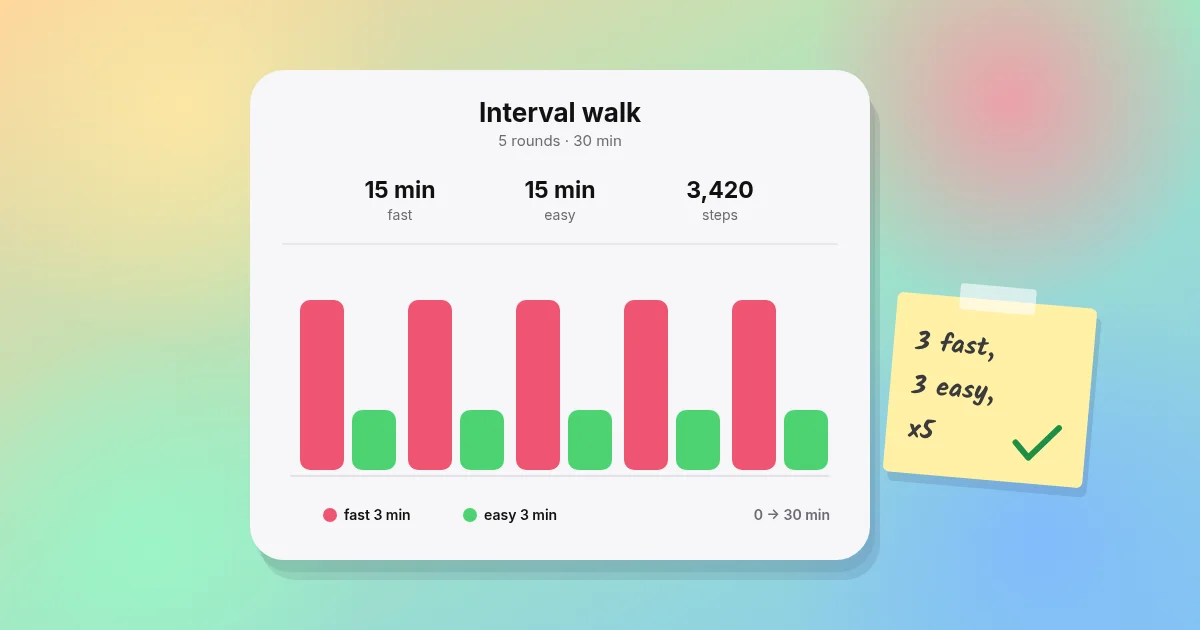
- "Japanese walking" is interval walking training (IWT) from Shinshu University: 3 minutes fast, 3 minutes easy, at least 5 rounds, 4+ days a week.
- In a 2007 trial of 246 adults aged 44–78, five months of IWT improved leg strength and aerobic fitness more than steady walking, and lowered systolic blood pressure more.
- A study of 679 people found that gains rose with fast-walking time up to about 50 minutes a week, then levelled off.
- It's a good, evidence-based routine, but it's not a weight-loss miracle. Most studies were in healthy middle-aged and older Japanese adults.
Yes, mostly. "Japanese walking" is a real, studied routine called interval walking training (IWT): 3 minutes of fast walking, then 3 minutes of easy walking, repeated at least five times, on four or more days a week. In a 2007 trial at Shinshu University, five months of it improved thigh strength and aerobic fitness more than steady walking, and brought a bigger drop in systolic blood pressure (Nemoto et al., 2007). What the research doesn't show is the miracle weight loss some viral videos imply.
Health disclaimer: This article is for general information and isn't medical advice. If you have heart, blood pressure, joint or other health conditions, or you're new to exercise, check with a doctor before starting intervals.
Does Japanese walking actually work?
For fitness, the evidence is good: several studies from the same research group, including a randomized trial, with consistent results. For blood pressure and "lifestyle-related disease" scores, the evidence is promising. For weight loss specifically, it's thin. We explain why below.
What is Japanese walking, exactly?
The protocol used in the research:
| Element | What the studies prescribed |
|---|---|
| Fast interval | 3 minutes at ≥70% of your peak walking aerobic capacity ("brisk, hard work") |
| Easy interval | 3 minutes at about 40% ("comfortable stroll") |
| Rounds | 5 or more per day (about 30 minutes) |
| Frequency | 4 or more days per week |
| Duration studied | 5 months (some programmes ran for 22 months) |
Source: Nemoto et al., 2007; Masuki et al., 2019.
Where did the routine come from?
It was developed by Hiroshi Nose, Shizue Masuki and colleagues at Shinshu University in Matsumoto, Japan, who studied it in thousands of middle-aged and older adults (Masuki et al., 2017).
It went viral much later. In 2025, a video by creator Eugene Teo passed 10 million views on TikTok and 17 million on YouTube (LA Times). Gym chain PureGym reported that searches rose 2,968% year on year in July–September 2025 (WIRED Japan). The name "Japanese walking" came from social media, not the researchers.
What did the original 2007 study find?
The key trial, published in Mayo Clinic Proceedings, randomly assigned 246 healthy adults aged 44–78 (average age 63) to one of three groups for five months (Nemoto et al., 2007):
- No walking training
- Steady walking: about 50% effort, 8,000+ steps a day, 4+ days a week
- Interval walking: 3 minutes fast / 3 minutes easy, 5+ rounds, 4+ days a week
Results in the interval group:
| Measure | Change after 5 months of interval walking |
|---|---|
| Knee extension strength (thigh front) | +13% |
| Knee flexion strength (thigh back) | +17% |
| Peak aerobic capacity, cycling | +8% |
| Peak aerobic capacity, walking | +9% |
| Resting systolic blood pressure | Fell more than in the steady-walking group |
All four fitness gains were significantly larger than in the steady-walking group (Nemoto et al., 2007).
One detail the viral videos skip: the interval group walked for only about 83% as long as the steady group, yet burned about the same energy per day, because the fast intervals were harder (Nemoto et al., 2007).
What has later research added?
- Fast minutes matter most. In 679 adults (average age 65) doing five months of IWT, aerobic capacity rose 14% and a lifestyle-related disease score fell 17% on average. Gains rose with fast-walking time up to about 50 minutes a week, then plateaued. Slow or total walking time didn't predict improvement (Masuki et al., 2019).
- People can stick with it. In a 22-month programme with 696 participants, average adherence was 70%. Higher adherence tracked with a 12% increase in aerobic capacity and a 13% drop in the disease score (Masuki et al., 2015).
- Outside Japan. A Danish randomized trial in people with type 2 diabetes found that four months of interval walking improved fitness, body composition and glucose control compared with steady walking matched for average intensity and time (Karstoft et al., 2013). That's one small trial in one condition. It's a reason to talk to your doctor, not a treatment plan.
What doesn't the research show?
- Not a weight-loss shortcut. The main trials focused on fitness, strength and blood pressure. Energy burn was about the same as steady walking (Nemoto et al., 2007). If weight is your goal, total activity and food still do the heavy lifting. We covered that in the easiest way to lose fat.
- Mostly one population. Most data comes from healthy, middle-aged and older Japanese adults, many of them women. Results in younger or less healthy people may differ.
- Equipment. Participants used a dedicated accelerometer device that measured their individual effort and beeped at each switch (Karstoft et al., 2013). Guessing your pace at home is less precise.
- One research group. Much of the evidence comes from the Shinshu team. Independent replication is growing but still limited.
How fast is "fast" in Japanese walking?
The studies set "fast" at 70% or more of each person's measured peak walking capacity, which most of us can't measure. Our practical rule of thumb (not from the studies): fast should feel hard enough that you can speak a few words but not hold a conversation, and easy should feel like a relaxed stroll. If you have an Apple Watch, a heart rate that climbs during fast intervals and settles during easy ones is a good sign you've got the contrast right.
How do you start Japanese walking?
- Warm up with a few minutes of easy walking.
- Set a 3-minute repeating timer (or use an interval app).
- Alternate fast and easy for five rounds, about 30 minutes in total.
- Do it 4 days a week. Short on time? Masuki's data suggests the fast minutes are what count. Aim for about 50 fast minutes a week (Masuki et al., 2019).
- Build up. Start with 2–3 rounds if 5 feels like too much.
How does it compare with other walking trends?
| Routine | What it is | Evidence |
|---|---|---|
| Japanese walking (IWT) | 3 min fast / 3 min easy × 5+, 4+ days/week | Randomized trials and large cohort studies (above) |
| 7,000+ steps a day | A daily step target | Large meta-analyses link it with lower risk; see 7,000 vs 10,000 steps |
| Norwegian 4x4 | 4 × 4 min very hard, 3 min easy | Strong for VO2 max; see how to increase VO2 max |
They work well together: hit your steps most days, and make some of those steps fast.
How can you track interval walks?
Your iPhone already counts steps, and an Apple Watch adds heart rate. Kinetic puts your walks, places and sleep on one automatic timeline, reading workouts and heart rate from Apple Health without writing anything back. No account, no ads. Your health data stays on your iPhone and we never see it. We'll never sell your data.
Kinetic arrives on the App Store Nov 3, with your first year free.
Sources
- Nemoto K, Gen-no H, Masuki S, Okazaki K, Nose H. Effects of high-intensity interval walking training on physical fitness and blood pressure in middle-aged and older people. Mayo Clinic Proceedings, 2007;82(7):803–811: https://pubmed.ncbi.nlm.nih.gov/17605959/ (DOI: https://doi.org/10.4065/82.7.803)
- Masuki S, Morikawa M, Nose H. High-intensity walking time is a key determinant to increase physical fitness and improve health outcomes after interval walking training. Mayo Clinic Proceedings, 2019: https://pubmed.ncbi.nlm.nih.gov/31477320/
- Masuki S, et al. The factors affecting adherence to a long-term interval walking training program in middle-aged and older people. Journal of Applied Physiology, 2015: https://journals.physiology.org/doi/full/10.1152/japplphysiol.00819.2014
- Masuki S, Morikawa M, Nose H. Interval walking training can increase physical fitness in middle-aged and older people. Exercise and Sport Sciences Reviews, 2017: https://doi.org/10.1249/jes.0000000000000113
- Karstoft K, et al. The effects of free-living interval-walking training on glycemic control, body composition, and physical fitness in type 2 diabetic patients. Diabetes Care, 2013: https://pmc.ncbi.nlm.nih.gov/articles/PMC3554285/
- LA Times, Japanese walking trend (Jul 2025): https://www.latimes.com/lifestyle/story/2025-07-31/japanese-walking-wellness-trend
- WIRED Japan, What is Japanese walking (PureGym search data): https://wired.jp/article/what-is-japanese-walking/