The Easiest Way to Lose Fat: Walk More, Eat Protein, Skip the Magic Numbers
Daily walks and high protein are a strong fat-loss combo, but not for the reasons you've heard. The science on fasted cardio, 'fat-burning zones' and protein.
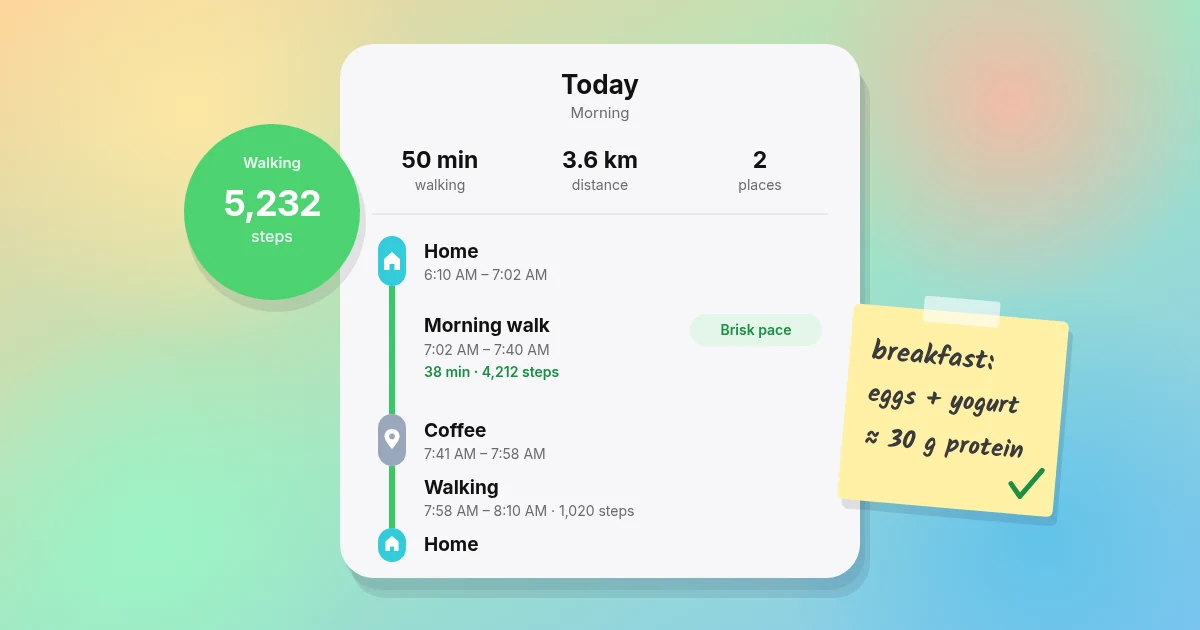
Key takeaways
- Fat loss comes down to a modest calorie deficit you can stick with. Low-carb vs. low-fat matters far less than the total.
- Walking makes the deficit easier and is easy to recover from, but exercise alone usually brings only modest weight loss.
- Fasted cardio burns more fat during the session, but in a controlled trial fasted and fed groups lost the same amount of fat.
- There's no universal "fat-burning" heart rate: 100–120 bpm is a noticeably different effort at 25 than at 65.
- About 1.6 g of protein per kg of body weight a day, plus lifting 2–3 times a week, helps you keep muscle while you lose fat.
There's a fat-loss plan that's been passed around gyms for decades: walk for 30+ minutes every morning, keep your heart rate between 100 and 120 bpm (the "prime fat-burning zone"), eat lots of protein, and you'll get shredded like a bodybuilder.
Here's the fun part. The habits in that plan are excellent. Several of the reasons given for them are myths. Let's keep the walking shoes and the chicken, and drop the pseudoscience.
The short answer: fat loss comes down to a modest calorie deficit you can stick with. Daily walking and plenty of protein make that deficit easier to hold and help you keep muscle. The exact heart rate, and whether you walk before breakfast, matter far less than the gym plan claims. Skip to the corrected plan if you just want the steps.
What actually causes fat loss? Energy balance
Fat loss happens when you consistently burn more energy than you eat. Reviews of decades of metabolic research conclude that energy balance is what drives changes in body fat. The body adapts as you lose weight, so progress slows, but the macronutrient mix (low-carb vs. low-fat) matters far less than the total (Hall & Guo, Gastroenterology 2017).
In the DIETFITS trial, 609 adults lost similar amounts of weight over a year on a healthy low-fat diet (about 5.3 kg) or a healthy low-carb diet (about 6.0 kg), and the difference wasn't significant (Gardner et al., JAMA 2018).
So the "easiest" fat-loss plan is whatever creates a modest deficit that you'll actually stick with. That's why walking and protein are such a good pair.
Why is walking underrated for fat loss?
Because it's an easy way to burn a bit more energy every day, and easy to repeat tomorrow.
It adds up without wrecking you
Walking is cheap, low-impact and easy to recover from. It also counts toward the 150+ minutes of weekly activity that the American College of Sports Medicine recommends for weight management (ACSM 2024 consensus).
Here's a rough idea of the energy cost. Activity researchers measure effort in METs (metabolic equivalents), where 1 MET is your energy use sitting at rest. The 2024 Compendium of Physical Activities lists level walking at 2.8–3.4 mph at 3.8 METs and brisk walking at 3.5–3.9 mph at 4.8 METs (Compendium, Walking).
Using the standard approximation (1 MET ≈ 1 kcal per kg per hour), an 80 kg (176 lb) person walking at a moderate pace for 30 minutes burns about 150 kcal in total, or about 110 kcal more than sitting still. That's an estimate, not a promise. Individuals vary, and your watch's number is an estimate too.
NEAT: the calories you don't notice
Non-exercise activity thermogenesis (NEAT) is all the movement that isn't formal exercise: walking to the shop, pacing on calls, taking stairs. In a classic overfeeding study, changes in NEAT explained about two-thirds of the increase in energy expenditure and much of the 10-fold difference in how much fat people gained (Levine et al., Science 1999). Daily steps are a simple way to keep an eye on it.
Steps matter for health beyond weight, too. A meta-analysis of 15 cohorts (47,471 adults) found mortality risk kept falling until roughly 6,000–8,000 steps per day for adults 60 and older, and 8,000–10,000 for younger adults (Paluch et al., Lancet Public Health 2022). That's observational data, but it's a useful target.
The honest catch
Exercise on its own usually produces modest weight loss. ACSM's position stand found that 150–250 minutes per week brings only modest weight loss, while more than 250 minutes per week is associated with clinically significant loss (Donnelly et al., ACSM 2009).
Total daily energy expenditure also seems to plateau at higher activity levels, as the body compensates (Pontzer et al., 2016). Walking makes the deficit easier, but you can't out-walk a large daily calorie surplus.
Does walking fasted or in the morning burn more fat?
Probably not by much. Fasted exercise burns more fat during the session but not more over weeks, and the case for mornings is thin. Pick the timing you'll actually keep.
Fasted vs. fed cardio
Doing cardio on an empty stomach does make you burn more fat during the session. A meta-analysis found fasted exercise increased fat oxidation (fat burning) during exercise compared with fed exercise (Vieira et al., Br J Nutr 2016).
Burning fat during a workout isn't the same as losing fat over weeks, though. When Schoenfeld and colleagues had women in a calorie deficit do an hour of cardio three times a week, fasted or after a meal, both groups lost weight and fat, with no difference between them (Schoenfeld et al., JISSN 2014). The body balances fuel use over the day.
Bottom line: walk fasted if you prefer it. Walk after breakfast if you prefer that. Choose whichever one you'll actually keep doing.
Is morning special?
Possibly a little, but the evidence is thin. In a secondary analysis of a 10-month trial, people who exercised early in the day lost more weight than those who exercised later, and the researchers couldn't explain the difference through energy intake or expenditure (Willis et al., Int J Obes 2020). Participants weren't randomized to a time of day, so it's not proof. The best argument for morning walks is practical: they happen before the day gets away from you.
Is 100–120 bpm really the fat-burning zone?
Not for everyone. The fat-burning zone is a real concept, but no single heart rate fits all ages, and it matters less than you'd think.
There is a real exercise intensity at which your body burns the most fat per minute, called Fatmax. In trained cyclists it averaged about 64% of VO2 max, or about 74% of maximum heart rate (Achten et al., 2002). In a larger study of 300 adults, it averaged about 48% of VO2 max, around 62% of max heart rate, with big differences between individuals and sexes (Venables et al., 2005).
Why a fixed 100–120 bpm doesn't fit everyone
Maximum heart rate falls with age. A widely used equation estimates it as 208 − 0.7 × age (Tanaka et al., 2001). Run the numbers:
| Age | Estimated max HR | 100–120 bpm as % of max |
|---|---|---|
| 25 | ~190 | ~52–63% |
| 45 | ~176 | ~57–68% |
| 65 | ~162 | ~62–74% |
The same heart rate is a gentle stroll for one person and a solid effort for another. Fitness, medications and even heat change things further. Formulas are averages, and your own max may be quite different.
Why the zone matters less than total energy balance
Even if you're exactly at Fatmax, what matters for fat loss is your total energy balance over days and weeks, not which fuel you burned during the workout. ACSM's 2024 consensus found no single exercise intensity or mode was superior for weight loss, and noted that lighter activity can work if total energy expenditure is high enough (ACSM 2024).
Better rule of thumb: walk briskly enough that you're breathing a bit harder but can still talk in sentences. Then focus on doing it often.
Is this really how bodybuilders get shredded?
Sort of. Bodybuilders really do use low-intensity cardio during contest prep, and some do it fasted. One case study of a natural bodybuilder included fasted morning HIIT and steady-state cardio. The authors chose fasted training because the athlete preferred it, and noted that controlled studies show no extra fat loss from fasting when calories are matched (Robinson et al., JISSN 2015).
A case report of six bodybuilders found that all did fasted aerobic exercise. Several also used drugs including anabolic steroids, ephedrine and diuretics, and the authors recommended avoiding fasted cardio (Gentil et al., 2017).
What actually gets bodybuilders lean is less exciting:
- A long, controlled calorie deficit. Surveyed high-level natural bodybuilders prepared for an average of 22 ± 9 weeks (Chappell et al., 2018). British professionals lost about 0.5% of body mass per week over roughly 28 weeks (Chappell et al., 2019).
- Resistance training plus high protein to hold on to muscle. Evidence-based prep guidelines suggest losing 0.5–1% of body weight per week with high protein (Helms et al., 2014).
- Cardio as a tool, used sparingly. Guidelines say cardio can enhance fat loss, but recommend the lowest dose that does the job. They add that "fasted cardiovascular training may not have benefits over fed-state and could be detrimental" (Helms et al., 2015).
Stage-lean is also temporary and hard on the body. In one 12-month case study, a natural bodybuilder dropped from 14.8% to 4.5% body fat during prep, then returned to 14.6% during recovery (Rossow et al., 2013). Borrow the habits, not the extremes.
How much protein do you need to lose fat?
About 1.6 g per kilogram of body weight per day is a solid default, and protein is the most useful part of the original plan.
The International Society of Sports Nutrition recommends 1.4–2.0 g/kg/day for most exercising people, and notes that higher intakes (2.3–3.1 g/kg) may help resistance-trained people stay lean while dieting (Jäger et al., ISSN 2017). For a 75 kg (165 lb) person, 1.6 g/kg is about 120 g a day: roughly 30 g across four meals.
If you have kidney disease or another medical condition, check with your doctor first.
Why it helps, in three ways:
- Protecting muscle. In a tough 4-week trial combining a 40% calorie deficit with intense training, young men eating 2.4 g/kg/day of protein gained lean mass and lost more fat than those eating 1.2 g/kg/day (Longland et al., AJCN 2016).
- Helping strength training pay off. A meta-analysis found protein boosted gains from resistance training, with benefits leveling off around 1.6 g/kg/day for most people (Morton et al., BJSM 2018).
- Fullness. Higher-protein diets can modestly improve satiety and body composition. Researchers suggest around 1.2–1.6 g/kg/day, with about 25–30 g per meal, and stress that sticking with the diet is what counts (Leidy et al., AJCN 2015).
Should you lift weights while losing fat?
Yes, mainly to hold on to muscle. Strength training doesn't burn huge numbers of calories, and on its own it doesn't speed up weight loss much. It does help you keep or build muscle while losing fat (ACSM 2009). WHO recommends muscle-strengthening activities on 2 or more days a week (Bull et al., 2020). Two or three full-body sessions a week is plenty to start.
The easy fat-loss plan, corrected
- Walk most days. Aim for 30–60 minutes, morning or whenever it sticks, at a brisk, conversational pace.
- Raise your daily steps gradually, for example by 1,000–2,000 per day over a few weeks.
- Eat in a modest deficit. Aim for roughly 0.5–1% of body weight per week.
- Eat protein at every meal, about 1.6 g/kg/day as a solid default.
- Lift 2–3 times a week.
- Be patient. Progress slows as your body adapts. That's normal, not failure.
Let your phone do the counting (without the creepy part)
Habits stick when you can see them. Kinetic automatically logs your steps, walks and workouts (and tags gym visits if you label your gym), then shows your day as a simple timeline.
Heart rate, sleep and workouts come from Apple Health, read-only. There's no account, no ads and no analytics. Your data stays on your iPhone and in your own iCloud, because we can't sell what we never see. It's free for the first year, then $19.99/year.
Want to get fitter as well as leaner? Our guide to raising your VO2 max covers what the research says about intervals and easy cardio.
Health disclaimer: This article is general information, not medical or nutritional advice. Talk to your doctor or a registered dietitian before changing your diet or exercise, especially if you have kidney disease, diabetes, heart conditions, are pregnant, or have a history of disordered eating. Weight loss that's very rapid, or a fixation on hitting extreme leanness, can be harmful.
Sources
- Hall KD, Guo J. Obesity energetics: body weight regulation and the effects of diet composition. Gastroenterology 2017
- Gardner CD, et al. Effect of low-fat vs low-carbohydrate diet on 12-month weight loss (DIETFITS). JAMA 2018
- Jakicic JM, et al. Physical activity and excess body weight and adiposity for adults: ACSM consensus statement. Med Sci Sports Exerc 2024
- 2024 Adult Compendium of Physical Activities, Walking
- Herrmann SD, et al. 2024 Adult Compendium of Physical Activities. J Sport Health Sci 2024
- Levine JA, et al. Role of nonexercise activity thermogenesis in resistance to fat gain in humans. Science 1999
- Paluch AE, et al. Daily steps and all-cause mortality: a meta-analysis of 15 international cohorts. Lancet Public Health 2022
- Donnelly JE, et al. ACSM position stand: appropriate physical activity intervention strategies for weight loss. Med Sci Sports Exerc 2009
- Pontzer H, et al. Constrained total energy expenditure and metabolic adaptation to physical activity. Curr Biol 2016
- Vieira AF, et al. Effects of aerobic exercise performed in fasted v. fed state on fat and carbohydrate metabolism: a meta-analysis. Br J Nutr 2016
- Schoenfeld BJ, et al. Body composition changes associated with fasted versus non-fasted aerobic exercise. JISSN 2014
- Willis EA, et al. Timing of exercise and weight loss (Midwest Exercise Trial 2). Int J Obes 2020
- Achten J, et al. Determination of the exercise intensity that elicits maximal fat oxidation. Med Sci Sports Exerc 2002
- Venables MC, et al. Determinants of fat oxidation during exercise in healthy men and women. J Appl Physiol 2005
- Tanaka H, et al. Age-predicted maximal heart rate revisited. J Am Coll Cardiol 2001
- Robinson SL, et al. A nutrition and conditioning intervention for natural bodybuilding contest preparation: case study. JISSN 2015
- Gentil P, et al. Nutrition, pharmacological and training strategies adopted by six bodybuilders. Eur J Transl Myol 2017
- Chappell AJ, et al. Nutritional strategies of high level natural bodybuilders during competition preparation. JISSN 2018
- Chappell AJ, et al. Nutritional strategies of British professional and amateur natural bodybuilders. JISSN 2019
- Helms ER, et al. Evidence-based recommendations for natural bodybuilding contest preparation: nutrition and supplementation. JISSN 2014
- Helms ER, et al. Recommendations for natural bodybuilding contest preparation: resistance and cardiovascular training. J Sports Med Phys Fitness 2015
- Rossow LM, et al. Natural bodybuilding competition preparation and recovery: a 12-month case study. IJSPP 2013
- Longland TM, et al. Higher compared with lower dietary protein during an energy deficit. Am J Clin Nutr 2016
- Morton RW, et al. Protein supplementation and resistance training-induced gains: meta-analysis. Br J Sports Med 2018
- Leidy HJ, et al. The role of protein in weight loss and maintenance. Am J Clin Nutr 2015
- Jäger R, et al. ISSN position stand: protein and exercise. JISSN 2017
- Bull FC, et al. WHO 2020 guidelines on physical activity and sedentary behaviour. Br J Sports Med 2020
- Kinetic