How to Increase Your VO2 Max (Without Falling for the Hype)
What the research says about raising VO2 max: Norwegian 4x4, Tabata, 30/30, sprint intervals, easy base training, plus how accurate Apple Watch Cardio Fitness is.
Key takeaways
- Training typically raises VO2 max by roughly 5–10%, and genetics explain a big share of how much you respond.
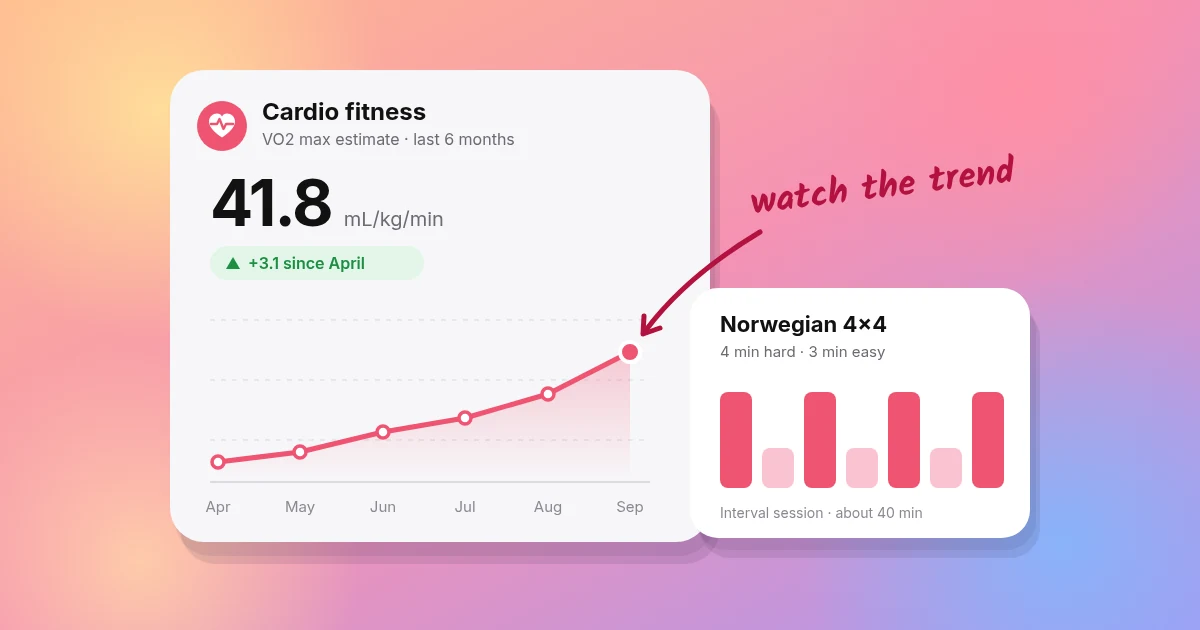
- Intervals are efficient, and longer ones like the Norwegian 4x4 (4 × 4 minutes hard, 3 minutes easy) have the strongest evidence.
- HIIT's edge over steady endurance training is real but small. Easy cardio builds the base, but the evidence doesn't back "Zone 2" as the best intensity for most people.
- Gains fade within weeks of stopping, so consistency and gradual progression pay off.
- Apple Watch Cardio Fitness is good for trends, not exact numbers: one independent study found it read about 6 mL/kg/min low on average.
VO2 max is having a moment. It shows up in podcasts, longevity books, and the Cardio Fitness tile on your Apple Watch that occasionally tells you you're "Below Average" while you're eating a croissant.
The short answer: do some hard intervals (longer ones, like the Norwegian 4x4, have the best evidence), build a base of easy cardio, and keep it up for months. Expect gains of roughly 5–10%, though your genes have a big say in how much you respond.
The hype has a real basis. VO2 max is the maximum rate at which your body can take in and use oxygen, and it's one of the better-studied markers of fitness:
- In a large meta-analysis, each 1-MET increase in cardiorespiratory fitness was associated with about a 13% lower risk of death from any cause (Kodama et al., JAMA 2009). (A MET, or metabolic equivalent, is roughly 3.5 mL/kg/min of oxygen.)
- A study of more than 122,000 patients who did treadmill tests found that higher fitness was associated with lower mortality, with no observed upper limit (Mandsager et al., JAMA Network Open 2018).
Both are observational, so they show association rather than proof that raising your number adds years. Still, it's a good number to nudge upward. Here's what the evidence says actually works, and how far to trust the number on your wrist.
How much can you raise your VO2 max?
Training programs typically raise VO2 max by roughly 5–10%, according to a review summarized in Apple's own white paper (Apple, 2021). Results vary a lot from person to person.
In the HERITAGE Family Study, 481 sedentary adults followed the same 20-week program. Average gains were about 400 mL/min, but some people barely improved while others gained more than 1 liter per minute, and about half of that variation in response was attributed to genetics (Bouchard et al., 1999).
The good news is that "non-responders" seem to mostly be people who haven't done enough yet. When researchers gave people more training (two extra sessions per week), non-response disappeared (Montero & Lundby, 2017). If your number isn't moving, the next step may simply be more training.
Method 1: High-intensity intervals (the heavy hitter)
Intervals are an efficient way to raise VO2 max, and longer intervals seem to work best. Here's how the best-known formats compare; details and caveats follow.
| Workout | Format | What the research found |
|---|---|---|
| Norwegian 4x4 | 4 × 4 min at 90–95% of max heart rate, 3 min easy | VO2 max up 7.2% in 8 weeks (Helgerud 2007) |
| 15/15 | 15 s hard, 15 s easy | Up 5.5% in the same study |
| Tabata (original) | 7–8 × 20 s at about 170% of VO2 max intensity, 10 s rest | Up about 7 mL/kg/min in 6 weeks, in 7 athletes (Tabata 1996) |
| Sprint intervals | Often 30 s all-out, several minutes' recovery | Up about 3.6 mL/kg/min vs. no exercise (Gist 2014) |
| 30/30 | 30 s at VO2 max pace, 30 s at half speed | More time at VO2 max in one session; long-term gains not tested (Billat 2000) |
The Norwegian 4x4
The famous version comes from Helgerud and colleagues. Forty moderately trained young men trained 3 days per week for 8 weeks, with total work matched across groups (Helgerud et al., 2007):
- 4×4 intervals: 4 minutes at 90–95% of maximum heart rate (HRmax), with 3 minutes of active recovery at about 70%, repeated 4 times. VO2 max rose 7.2%.
- 15/15 intervals: 15 seconds hard, 15 seconds easy. VO2 max rose 5.5%.
- Long slow distance (70% HRmax) and lactate-threshold runs (85% HRmax): no significant change.
How to do it: warm up for 10 minutes. Then do 4 rounds of 4 minutes "hard but sustainable" (you can say a couple of words, not a sentence), each followed by 3 minutes of easy movement. Cool down. It takes about 40 minutes and works on a bike, a rower, an incline treadmill or a hill.
Tabata (the original, not the gym-class version)
In the 1996 Tabata study, 7 athletes did 7–8 rounds of 20 seconds at about 170% of VO2 max intensity, with 10 seconds of rest, 5 days a week for 6 weeks. VO2 max rose by about 7 mL/kg/min and anaerobic capacity by 28% (Tabata et al., 1996). For comparison, a group doing an hour of moderate training also improved VO2 max, but not anaerobic capacity.
Caveats: it was a tiny study, and the protocol was exhausting by design. If your "Tabata" class leaves you able to chat about weekend plans, it's not the same thing.
Sprint interval training (SIT)
Sprint intervals are short, all-out efforts, often 30-second sprints with several minutes of recovery. A meta-analysis found that SIT raised VO2 max by about 3.6 mL/kg/min (roughly 8%) compared with no exercise. It performed about the same as traditional endurance training, for much less time spent (Gist et al., 2014).
30/30s and other short intervals
In 30/30 intervals you alternate 30 seconds at your VO2 max pace with 30 seconds at half that speed. In one lab study, runners spent nearly 8 minutes at VO2 max during a 30/30 session, compared with under 3 minutes in a continuous hard run (Billat et al., 2000). That was a single-session study, so it shows the workout puts you in the right zone, not long-term gains. It's a good option if 4-minute repeats feel brutal.
So is HIIT "better"?
It helps, but less than social media suggests. A meta-analysis of 28 studies found that HIIT improved VO2 max by about 5.5 mL/kg/min versus 4.9 for endurance training, a small extra benefit of about 1.2 mL/kg/min (Milanović et al., 2015).
Another analysis of 53 trials found that protocols with longer intervals (2 minutes or more), more total hard time (15+ minutes per session) and programs of several weeks worked best, and were the ones most likely to beat moderate continuous training (Wen et al., 2019). Longer intervals also stood out in an earlier meta-analysis (Bacon et al., 2013).
Translation: intervals are an efficient tool, and longer intervals in the 4x4 style seem particularly effective. They aren't magic.
Method 2: Easy volume (the "Zone 2" debate)
"Zone 2" is the popular label for easy, steady cardio. It's a useful foundation, but probably not the magic intensity it's sold as. Endurance athletes do most of their training at low intensity. Analyses of elite athletes show roughly 80% of sessions are easy and about 20% hard (Seiler, 2010). In well-trained athletes, a "polarized" mix of mostly easy work plus some hard intervals improved VO2 peak (the highest oxygen uptake reached in a test) more than threshold-heavy or high-volume-only training (Stöggl & Sperlich, 2014).
That doesn't mean slow work is the secret for everyone. A 2025 review concluded that the evidence doesn't support "Zone 2" as the optimal intensity for improving fitness in the general population. Higher intensities matter, especially when training time is limited (Storoschuk et al., 2025).
The practical version: easy cardio builds the base, lets you train more often without wrecking yourself, and is good for health in its own right. If you have 2.5 hours a week, include some hard work. If you have 8 hours a week, most of it should be easy.
Method 3: Lose excess body fat (math, not magic)
Losing fat raises your VO2 max score even if your heart and lungs haven't changed. Apple Watch and most tests report VO2 max relative to body weight (mL/kg/min). If you lose fat while your heart and lungs stay just as capable, your relative VO2 max goes up because you're dividing by a smaller number. It's real in the sense that you'll move your body more easily, but it isn't the same as improving your cardiovascular engine. If fat loss is on your list anyway, here's the low-drama approach with walking and protein.
Method 4: Consistency and progression
Fitness gains fade fast when you stop, and grow when you gradually do more.
- Don't stop. In trained endurance athletes, VO2 max fell about 7% within 21 days of stopping training and about 16% by 56 days (Coyle et al., 1984).
- Progress gradually: add a round, extend intervals, or add an easy session. Bigger training doses lead to more people responding (Montero & Lundby, 2017).
- Hit the basics. WHO recommends 150–300 minutes of moderate or 75–150 minutes of vigorous activity per week (or a mix), plus muscle-strengthening activities on 2 or more days (Bull et al., 2020).
Does altitude training raise VO2 max?
Not reliably. Altitude training is mostly an elite tool, and the evidence is mixed. A meta-analysis found that "live high, train low" likely improves performance in sub-elite athletes, while effects on VO2 max were inconsistent and possibly negative in elite athletes. Placebo and training-camp effects make the results harder to interpret (Bonetti & Hopkins, 2009). For most people, a hilly route is a better investment than a hypoxic tent.
How do age and genetics limit VO2 max?
Both set limits on your number, but neither makes training pointless. VO2 max declines with age: in the Baltimore Longitudinal Study of Aging, the decline was about 3–6% per decade in the 20s and 30s, accelerating to more than 20% per decade in the 70s and beyond (Fleg et al., 2005). Genetics shape both where you start and how much you respond (Bouchard et al., 1999). You can't pick your parents, but trained people at any age generally do better than untrained people of the same age.
How accurate is Apple Watch VO2 max?
Accurate enough to follow your trend, not to trust as an exact number.
How the estimate works
Apple Watch (Series 3 and later) estimates Cardio Fitness during Outdoor Walk, Outdoor Run or Hiking workouts. It uses heart rate, GPS pace and your profile (age, sex, weight, height, and medications that affect heart rate). It reports values from 14 to 65 mL/kg/min, and needs at least a day of wear plus some qualifying workouts before the first estimate (Apple Support).
It's a submaximal estimate: it doesn't push you to your limit the way a lab test does. In Apple's own validation, the average error was 1.4 mL/kg/min, but that was against a submaximal reference test, not a maximal lab test (Apple white paper, 2021). Apple notes that estimates can be skewed by heavy backpacks, sand, heat, caffeine, dehydration or recently arriving at altitude, and that heart-rate-lowering medications like beta blockers need to be entered in the Health app (same source).
What independent testing found
An independent 2025 study compared Apple Watch with lab-measured VO2 max in mostly young, fit adults. On average the watch underestimated by about 6 mL/kg/min, with a mean absolute percentage error of about 13%. The authors concluded it's useful for tracking general trends, not for clinical decisions (Lambe et al., PLOS ONE 2025).
How to use it: watch the trend over months, ideally on similar routes in similar conditions. Don't panic about a single reading.
Sample weekly plans to raise VO2 max
If you have a heart condition, take heart-rate-affecting medication or have been inactive, read the health note at the end of this article before you start.
Use "talk test" intensity cues: easy = full sentences, hard = a few words at a time. Warm up for 10 minutes before every interval session and cool down for 5–10 minutes after.
Beginner (new to structured cardio, about 2.5–3 hours per week)
Weeks 1–4: build the habit
| Day | Session |
|---|---|
| Mon | 30 min brisk walk or easy jog/cycle |
| Tue | Full-body strength, 30 min |
| Wed | 30 min easy cardio |
| Thu | Rest or a relaxed walk |
| Fri | 30 min easy cardio, with 6 × 20-second pick-ups |
| Sat | Strength, 30 min, plus a 45-min walk or hike |
| Sun | Rest |
Weeks 5–12: add one interval session
- Swap Friday for intervals: 5–6 × 1 min hard / 2 min easy. Progress toward 4 × 3 min hard / 3 min easy, and finally toward a full 4x4.
- Keep the other cardio days easy. Add 5 minutes to one easy session every week or two.
Intermediate (already active 3–5 days per week, about 4–6 hours per week)
| Day | Session |
|---|---|
| Mon | Norwegian 4x4 (4 × 4 min at 90–95% HRmax, 3 min easy) |
| Tue | 45 min easy + strength |
| Wed | 40–60 min easy (true conversation pace) |
| Thu | Short intervals: 2–3 sets of 10 × 30s hard / 30s easy (or 15/15), 3 min between sets |
| Fri | Rest or mobility |
| Sat | Long easy session, 75–120 min (run, ride, hike) |
| Sun | Strength + optional easy 30 min |
That's about two hard sessions out of six or seven, close to the roughly 80/20 split used by endurance athletes. Every 3–4 weeks, take an easier week. Retest by repeating a familiar outdoor route or a time trial, or by checking your watch trend.
How to track your progress without oversharing
Fitness tracking works best when it's automatic and boring (here's why automatic trackers got so rare). Kinetic quietly logs your walks, rides and workouts and reads heart rate and workouts from Apple Health (read-only), then lays it all out as a daily timeline you can scroll back through.
There's no account, no ads and no analytics, and data stays on your iPhone with backup to your own iCloud. We can't sell what we never see. It's free for the first year, then $19.99/year.
Health disclaimer: This article is for general information and isn't medical advice. High-intensity exercise isn't right for everyone. Talk to a doctor before starting a new program, especially if you have heart disease, high blood pressure, take heart-rate-affecting medication, are pregnant, or have been inactive. Stop exercising and seek care if you feel chest pain, faintness or unusual shortness of breath.
Sources
- Kodama S, et al. Cardiorespiratory fitness as a quantitative predictor of all-cause mortality. JAMA 2009
- Mandsager K, et al. Association of cardiorespiratory fitness with long-term mortality. JAMA Netw Open 2018
- Apple. Using Apple Watch to Estimate Cardio Fitness with VO2 max (white paper, 2021)
- Apple Support. Cardio Fitness levels on Apple Watch
- Bouchard C, et al. Familial aggregation of VO2max response to exercise training (HERITAGE). J Appl Physiol 1999
- Montero D, Lundby C. Refuting the myth of non-response to exercise training. J Physiol 2017
- Helgerud J, et al. Aerobic high-intensity intervals improve VO2max more than moderate training. Med Sci Sports Exerc 2007
- Tabata I, et al. Effects of moderate-intensity endurance and high-intensity intermittent training. Med Sci Sports Exerc 1996
- Gist NH, et al. Sprint interval training effects on aerobic capacity: a systematic review and meta-analysis. Sports Med 2014
- Billat VL, et al. Intermittent runs at the velocity associated with maximal oxygen uptake. Eur J Appl Physiol 2000
- Milanović Z, et al. Effectiveness of HIT vs continuous endurance training for VO2max improvements. Sports Med 2015
- Wen D, et al. Effects of different protocols of HIIT on VO2max: a systematic review and meta-analysis. J Sci Med Sport 2019
- Bacon AP, et al. VO2max trainability and high intensity interval training. PLoS One 2013
- Seiler S. What is best practice for training intensity and duration distribution in endurance athletes? IJSPP 2010
- Stöggl T, Sperlich B. Polarized training has greater impact on key endurance variables. Front Physiol 2014
- Storoschuk KL, et al. Much Ado About Zone 2. Sports Med 2025
- Coyle EF, et al. Time course of loss of adaptations after stopping prolonged intense endurance training. J Appl Physiol 1984
- Bull FC, et al. WHO 2020 guidelines on physical activity and sedentary behaviour. Br J Sports Med 2020
- Bonetti DL, Hopkins WG. Sea-level exercise performance following adaptation to hypoxia: a meta-analysis. Sports Med 2009
- Fleg JL, et al. Accelerated longitudinal decline of aerobic capacity in healthy older adults. Circulation 2005
- Lambe R, et al. Investigating the accuracy of Apple Watch VO2 max measurements. PLOS ONE 2025
- Kinetic